Core concepts
The supply-chain graph
HodeiShield models your third-party ecosystem as a directed graph, not a flat list:
| Element | Description | Example |
|---|---|---|
| Node | An entity: vendor, product, or your own organization | Cloud provider X |
| Edge | A dependency relationship between two nodes | Your app depends on Cloud provider X |
| Weight | The strength of the dependency, used to propagate risk | Critical = 1.0, support = 0.3 |
An incident on one node doesn't stay isolated: it propagates along edges by weight, so a fourth-party's risk (your vendor's own vendor) can also reach your score.
Dependency types
| Type | Impact if it fails |
|---|---|
| Critical | Interrupts service or exposes sensitive data |
| Operational | Degrades a function, without full interruption |
| Support | Limited, usually reversible impact |
| Sub-processor | Processes data on behalf of a direct vendor |
| Reseller | Commercial intermediary, no direct technical access |
Criticality
Each vendor gets a criticality level (critical / high / medium / low) that multiplies its risk score and decides how often it gets re-scanned.
Systemic risk
When several critical vendors depend, in turn, on the same fourth party, that fourth party concentrates a risk no single direct relationship shows on its own. HodeiShield surfaces this concentration explicitly in the graph, instead of hiding it behind N independent scores.
How the risk score is computed (0–100)
| Component | Weight | Source |
|---|---|---|
| Security scan | 35–50% | Automated scan result |
| Questionnaire | 25–40% | Vendor self-assessment |
| Known CVEs | 20–35% | Vulnerabilities in declared assets |
When one component is missing, the weights of the others rise: for example, with only CVE data the CVE component weighs 60%. The base score is adjusted with modifiers: vendor access level (the final score is multiplied by 1.3 for critical access, 1.15 for high, 1.0 for medium and 0.85 for low), time since the last re-scan, risk propagated from the vendor's own dependencies, active certifications (which reduce it), and dependency concentration on a single fourth party.
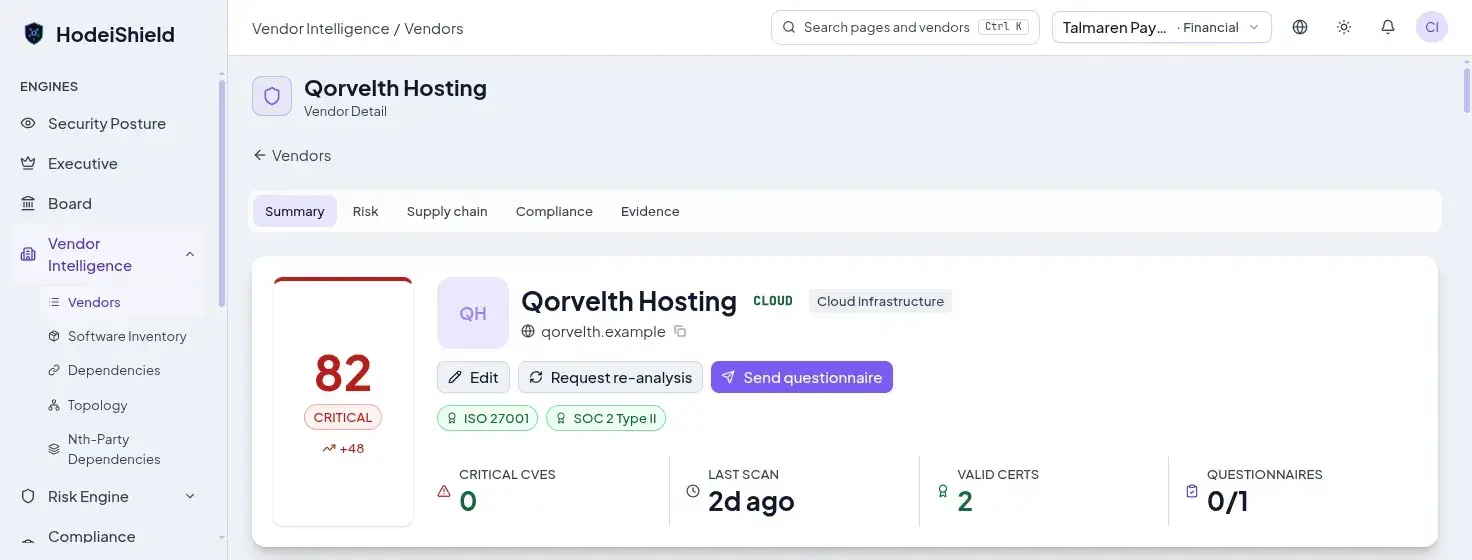
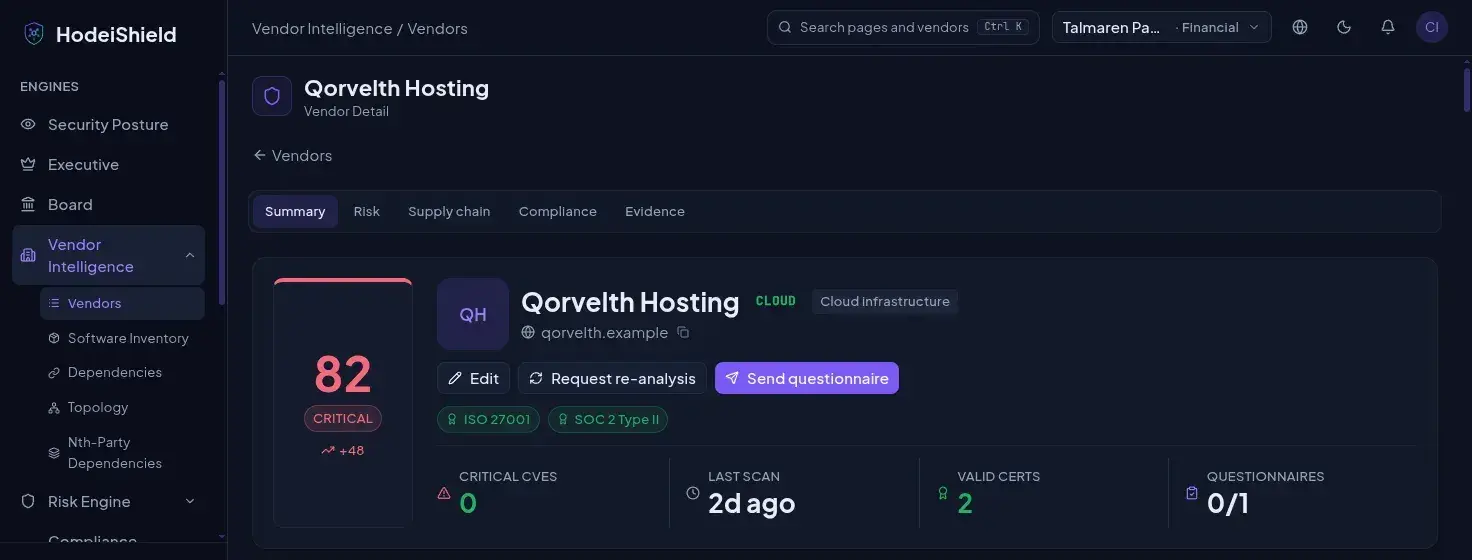
A vendor's summary card: composite score, severity band, valid certifications, and critical CVE count.
Next step
- Risk engine — from the score to financial exposure.
- Getting started — add your first vendor.