Risk engine
The risk engine combines three signal sources (scan, questionnaire, CVEs — see Core concepts) into a 0–100 score per vendor, surfaced through two complementary views:
Composite score
The operational view: a number, a severity band (critical / high / medium / low / informational), and the concrete findings that explain it, each linked to its supporting evidence.
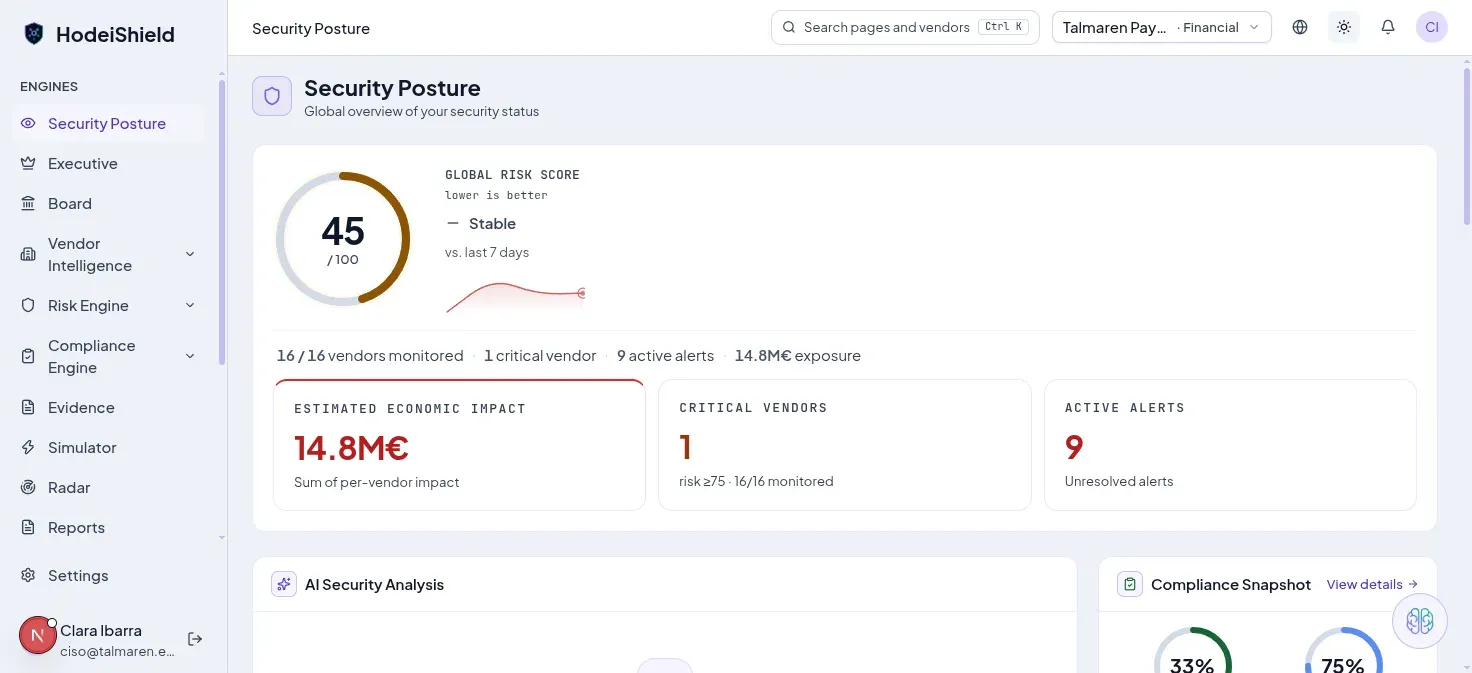
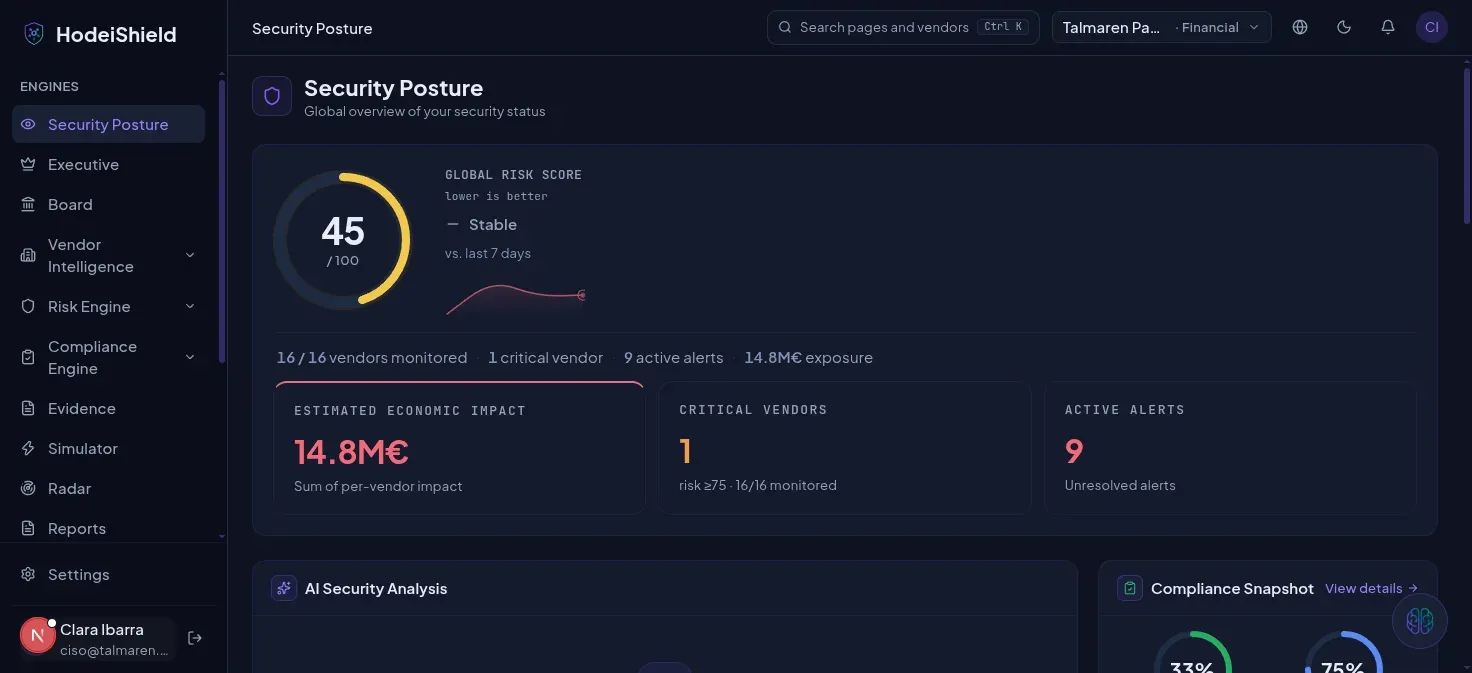
The main dashboard: global score (0–100, lower is better), aggregate economic impact and critical vendors at a glance.
Financial exposure (FAIR/ALE)
Operate plan and above
The leadership view: the same risk score, translated into an expected annual loss in euros using the FAIR method (Factor Analysis of Information Risk). It lets you compare heterogeneous vendors — a cloud provider and a consultancy — in the same unit, and prioritize remediation by economic impact, not only by technical severity.
Automatic re-scanning
A scan result is cached for a time that depends on the tenant's plan — once it expires, the next visit to the vendor's detail page triggers a fresh scan:
| Plan | Scan cache | On-demand re-scan |
|---|---|---|
| Operate / Enterprise | 24 hours | Yes, with a minimum 24h gap between requests |
| Automate / Trial | 48 hours | Yes, with a minimum 48h gap between requests |
| Essentials / AI Governance / Free | 7 days | Not available on this plan |
The cache time can be adjusted per vendor according to its criticality.
What a scan looks at
- DNS and TLS certificates
- Attack-surface exposure
- Known data breaches associated with the domain
- AI-assisted analysis (OVHcloud AI Endpoints) of the collected evidence
Shared infrastructure
A scan reaches a supplier's public address. When that address belongs to a content delivery network (CDN), a shared platform or a cloud provider, a finding on it may describe the provider's equipment and not the supplier's own server. Each finding is therefore tagged with the provider it was attributed to and how sure we are, and its weight in the technical score depends on the kind of infrastructure:
| Kind of infrastructure | Weight of the finding in the score |
|---|---|
| CDN edge | Not counted |
| Shared platform | A quarter |
| Cloud instance of the supplier | Counted in full |
The vendor page shows the tag on each finding, how many findings are excluded and why, and how many sit on shared infrastructure. When a decision changes a score, the change appears in the supplier's score history. A finding marked as an accepted risk keeps its weight and is tagged as accepted. A finding marked as a false positive, or one the supplier disputed and you accepted, stops counting.
Continuous monitoring
Beyond the periodic re-scan cycle, some findings (a newly published critical CVE, a new breach) trigger an immediate re-evaluation of the affected vendor, without waiting for the next cycle — and an alert if you have a routing rule configured for that event type (see Getting started → Set up alerts).